
Miquel Solà (UdG) — Nanographenes for Li-S battery applications
Don't miss any Success Story following us on X and LinkedIn!
@RES_HPC RES - Red Española de Supercomputación @res-icts.bsky.social
Check this Success Story at our LinkedIn: Nanographenes for Li-S battery applications
💡 A RES Success Story about advancing next-generation energy storage💡
📋 "Nanographenes for Li-S battery applications" led by Miquel Solà from Universitat de Girona
Lithium-sulfur (Li-S) batteries are among the most promising technologies for next-generation energy, but suffer from severe surface degradation and irreversible loss of active sulfur, undermining their comercial potential. One promising solution is the use of nanographenes as a protective interface layer on the lithium anode to suppress this detrimental effect.
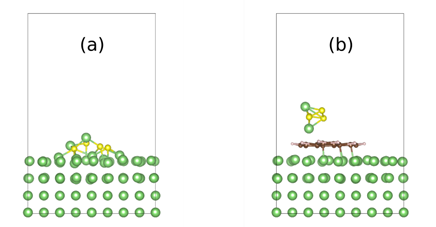
🖥️ Thanks to RES supercomputer #MareNostrum5 from Barcelona Supercomputing Center, the team explored nanographenes with different sizes and edge structures to understand how they interact with the lithium anode and the polysulfides at the atomic level. The results showed that, without nanographene coverage, polysulfides undergo spontaneous dissociation upon contact with lithium, causing permanent damage and continuous capacity fading. In contrast, when they applied the nanographene coverage, it adsorbed the polysulfides with moderate binding energies, acting as both a physical and a chemical barrier. These moderate energies allow polysulfides to migrate back to the cathode, maintaining the redox cycle and preserving sulfur utilization.
📸 The image shows polysulfide adsorption (a) without and (b) with deposited nanographenes on Li-anode surface.
📋 "Nanographenes for Li-S battery applications" led by Miquel Solà from Universitat de Girona
Lithium-sulfur (Li-S) batteries are among the most promising technologies for next-generation energy, but suffer from severe surface degradation and irreversible loss of active sulfur, undermining their comercial potential. One promising solution is the use of nanographenes as a protective interface layer on the lithium anode to suppress this detrimental effect.
🖥️ Thanks to RES supercomputer #MareNostrum5 from Barcelona Supercomputing Center, the team explored nanographenes with different sizes and edge structures to understand how they interact with the lithium anode and the polysulfides at the atomic level. The results showed that, without nanographene coverage, polysulfides undergo spontaneous dissociation upon contact with lithium, causing permanent damage and continuous capacity fading. In contrast, when they applied the nanographene coverage, it adsorbed the polysulfides with moderate binding energies, acting as both a physical and a chemical barrier. These moderate energies allow polysulfides to migrate back to the cathode, maintaining the redox cycle and preserving sulfur utilization.
📸 The image shows polysulfide adsorption (a) without and (b) with deposited nanographenes on Li-anode surface.